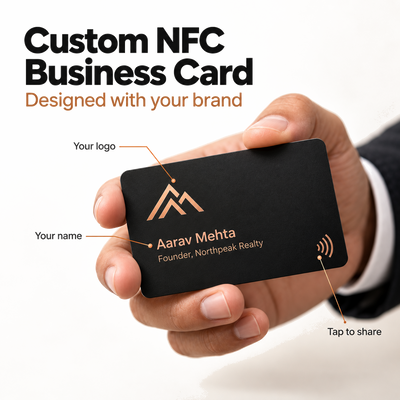
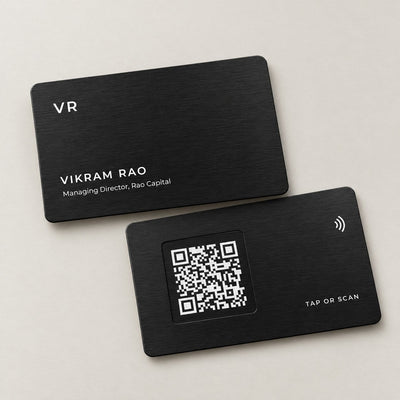
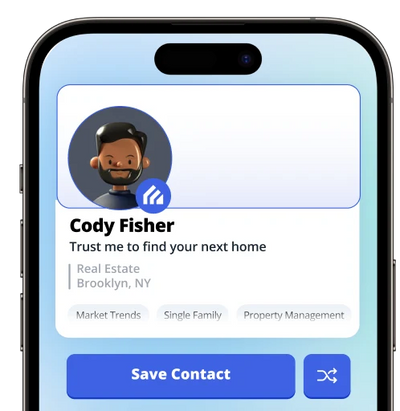
Most comparisons of this kind are written by someone who sells one of the two things. This one is written by someone who sells both, which at least means there is no thumb on the scale.
The short answer is that they are not really competitors. They fail in different situations, and the people who get the most out of either are usually carrying both. Here is the actual breakdown.
Where the NFC card genuinely wins
Your details are no longer frozen
This is the real argument and everything else is secondary. A printed card is accurate on the day it is printed and slowly becomes wrong. You change roles, your number changes, the company rebrands, and every card in circulation is now quietly misinforming people.
An NFC card stores a link, not your details, so updating the profile updates every card you have ever handed out. A card from two years ago opens current information. If you have ever had to say "ignore the number on that, here is my new one", you already understand the value.
If you want to see what the profile behind the card can hold, it is covered on the Rizely Profile page.
The contact actually lands in their phone
Here is the honest failure mode of paper: someone takes your card, puts it in a pocket, and it goes into a drawer with forty others. The exchange felt successful and produced nothing.
A tap opens a profile with a save-contact button on it. The details go into their phone while you are still standing there. The number of steps between "we met" and "your number is in their contacts" drops from about six to about one, and every step you remove is a step where the lead used to disappear.
You can put things on it that do not fit on paper
A printed card holds a name, a title, a number, an email, and maybe a logo. A profile holds a WhatsApp link, a calendar booking link, a portfolio, a catalogue, a map to your office, a payment link, and a video. In India specifically, a direct WhatsApp link is worth more than an email address on most cards, and there is no good way to print one.
You stop running out
One card, unlimited taps. You are not counting how many are left in the case before a conference.
Where paper genuinely wins
These are real and they get glossed over constantly.
Cost per handout, at volume
If you are working a trade show stand and expect to hand out four hundred cards in two days, you hand out four hundred printed cards. You do not hand out four hundred NFC cards. The economics are not close and pretending otherwise is dishonest.
NFC is a one-card-that-stays-with-you product. Paper is a leave-behind. The moment the card leaves your hand permanently, paper is the correct tool, which is why printed visiting cards have not gone anywhere.
It works with no phone, no battery, no signal
A printed card does not care whether their phone is dead, whether NFC is switched off, whether they are in a basement with no data, or whether they are eleven years into an old handset. It works in a lift, in a factory, and in a village with no tower. That reliability is not nothing.
Some rooms expect it
There are settings, government offices, older business relationships, certain formal introductions, where producing a phone instead of a card reads as a small breach of protocol. This varies enormously by industry and by city and you probably already know which rooms you are in.
It is a physical object people keep
A well-made card on good stock with a spot UV finish gets kept on a desk. A link does not. Paper still does object-permanence better than anything digital.
Where the comparison is usually faked
A few claims that get repeated and do not survive contact with reality.
"NFC cards are more environmentally friendly." A PVC card is plastic with a silicon chip in it. A paper card is paper. If you hand out one NFC card for three years, the arithmetic probably favours the NFC card. If you buy fifty of them for a team and replace them when the branding changes, it does not. The honest version is that this depends entirely on how many you buy and how long you keep them, and anyone stating it as a flat fact has not done the sum.
"Paper cards get thrown away, NFC cards do not." Your NFC card stays with you, so of course it does not get thrown away. It was never in their pocket to begin with. The thing that has to survive is the saved contact, not the card.
"NFC is more professional." Not inherently. A cheap PVC NFC card with a misaligned print is less impressive than a well-made paper card. The material and the finish do this work, not the technology.
The comparison in a table
| NFC card | Printed card | |
|---|---|---|
| Details can be updated later | Yes | No |
| Cost per person you meet | Falls toward zero | Fixed, per card |
| Suitable as a leave-behind at volume | No | Yes |
| Works with a dead or old phone | QR fallback only | Always |
| Can carry a WhatsApp or booking link | Yes | No |
| Contact saved during the conversation | Usually | Rarely |
| Runs out | No | Yes |
| Upfront cost | Higher | Lower |
What most people actually end up doing
The pattern that works, and it is boring but it is right:
- One NFC card that lives in your wallet. Used in conversations where you have thirty seconds and the person is holding their phone. This is most one-to-one meetings.
- A stack of printed cards for volume. Events, stands, reception desks, anywhere the card has to leave your hand and not come back.
- A QR code on both. On the NFC card it covers the phones that cannot tap. On the printed card it turns a dead-end into a link to the same profile, which quietly gives your paper cards the update-later property too.
That last point is underrated. Putting your profile QR on your printed cards costs nothing and means a card printed today still routes to current information in two years.
If you are choosing for a team
The calculation changes. For a sales team, the per-person NFC card pays for itself quickly because each rep is having dozens of one-to-one conversations a month and the saved-contact rate is the whole job. For a team that mans exhibition stands, printed cards at volume plus a shared tap display on the counter usually beats buying everyone a card.
Most teams need both, split by role rather than by preference. The rollout mechanics are covered in Rizely for teams.
So which one
If you meet people one at a time and your details change, get an NFC card. A PVC NFC card is the cheapest honest entry point.
If you hand out cards by the fistful, get printed cards and put a QR on them.
If you do both, which is most people, do both. They cost less together than the leads lost by picking one badly.